
IP Resources Management
Language Notice: Please note that this translation has been provided at best effort, for your convenience. The English page remains the official version.
Introduction
AFRINIC is the Regional Internet Registry (RIR) for Africa and the Indian Ocean and ensures fair management and distribution of Internet number resources in the African region.
Summary of Resources Managed
| IPv4 | IPv6 | ASN |
|---|---|---|
| 1. 41/8 2. 102/8 3. 105/8 4. 196/8 5. 197/8 6. other fragments. |
1. 2001:4200::/23 2. 2c0e::/12 |
1. AS33762 - AS33791 2. AS36864 - AS37887 3. AS327680 - AS328703 4. AS328704 - AS329727 5. AS329728 - AS330751 6. Various ASNs |
WHOIS
AFRINIC maintains a WHOIS database which holds information about the resources issued to its resource members as well as organisations in its service region which received resources before the RIR system was established (Commonly known as Legacy Resource Holders).
The database can be queried using a command-line client (e.g. under Unix/Linux), as well as a web-based whois client.
How does AFRINIC handle resource requests?
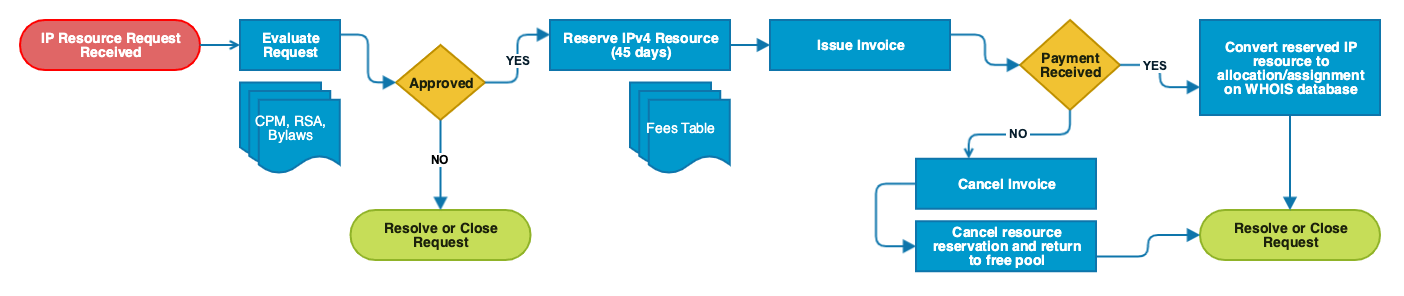
AFRINIC evaluates resource requests against the guidelines provided by the ratified policies in the Consolidated Policy Manual.
Once the resources are approved, IPv4 resources are temporarily marked as reserved (IPv6 prefixes & ASNs are not reserved in this way), and the member has invoiced the corresponding fees (allocation/assignment fee) based on the fees table available here.
In the case of new members, they are also billed a pro-rated annual membership fee in addition to any allocation/assignment fees. The invoice validity is 45 days for both existing resource members requesting for additional resources and prospective members.
After the fees are settled, the resources are issued to the resource member and registered as such in the AFRINIC WHOIS database. In the event that the fees are not settled, any temporary reservation is released and the affected resources return to the available pool.
What is the AFRINIC inventory?
The AFRINIC inventory consists of all the above resources. The resources in the inventory have various states:
- Available - These resources are available and shall be issued to resource members who can satisfy the applicable resource policies as allocations or assignments.
- Allocated/Assigned - They are registered on the AFRINIC WHOIS database to an organisation. The latter can be either an AFRINIC Resource Member or an organisation that received IP resources before the RIR system was established.
- Reserved - Not available for allocations and assignments.
There are three types of reservations that we currently do at AFRINIC.
- Policy reservations - Some policies that have been ratified mandate AFRINIC to reserve an IP prefix. The size is stipulated in the policy documentation. Some reference sections of the CPM are 11.4 and 5.4.7.1.
- Temporary reservations - Prefixes limited to the size of the approved allocation/assignment is reserved for 45 days for both existing member or a new member, while the resource member/applicant makes arrangements to settle the allocation/assignment fees they were billed. If the invoices expire and no payment is received, these reservations go back to the available pool.
The resource member is not given any details about the reserved prefix.
This is done to ensure uniformity between the operational level view and the community level view of the resource availability at any instance during the soft landing period; this is necessitated by the adoption of the first in first out approach for resource evaluation in the soft landing period. To ensure that AFRINIC fulfils its role of issuing resources once payment is received within the validity period of the invoice, the temporary reservation had to be introduced for the specific period an invoice is valid. This enables AFRINIC to mitigate the risk of approving more than it can issue, assuming that all issued invoices are settled in time.
- Quarantine - When resource members default on the payment of their annual membership fees, they breach the Registration Service Agreement (RSA). AFRINIC, therefore, enforces its Member Closure Process entailing reclamation of the resources held by the resource member and nullifying the RSA. The resources are kept in quarantine for a period of time.
Resource status on the AFRINIC WHOIS database
IPv4
Resources can have different Status in the AFRINIC WHOIS database including a reserved status as per certain policies.
The different values the status attribute for an IPv4 resource on the AFRINIC WHOIS database are summarised below:
- ALLOCATED PA - This status is given to resources issued by AFRINIC to its LIR Resource members. Such prefixes are to be used on the LIR's infrastructure and their customers (End-Users).
- ALLOCATED UNSPECIFIED - This status is used by AFRINIC in placeholder records on certain records, for example, 41.0.0.0/8.
- SUB-ALLOCATED PA - This status is given to IP address prefixes that have been sub-allocated by an LIR to its customer, also an ISP and will be further distributed to the ISP's customers.
- ASSIGNED PA - This status is given to IP addresses registered as being assigned by an LIR to its infrastructure and customers.
- ASSIGNED PI - This status is given to resources issued by AFRINIC to its Resource members (also called End Sites) to be used on their own infrastructure.
- ASSIGNED ANYCAST - This status is given to resources that get issued under the Assigned Anycast policy.
- POLICY-RESERVED - This status is given to resources that AFRINIC has to reserve to comply with policies that have been ratified, for example, 196.60.0.0/16.
IPv6
IPv6 Resources can have different Status on the AFRINIC WHOIS database. They are as follows:
- ALLOCATED-BY-RIR - This status is given to IPv6 resources issued by AFRINIC to Resource members - LIRs and are to be used on the LIR's infrastructure and their customers (End-Users).
- ASSIGNED PI - This status is given to IPv6 resources issued by AFRINIC to its Resource members - End-Users to be used on their own infrastructure.
- ASSIGNED ANYCAST - This status is given to IPv6 resources that get issued under the Assigned Anycast policy.
ASN
- ASSIGNED -This status is given to AS numbers issued to both LIR and End-User category.
- ASSIGNED-ANYCAST - This status is given to ASN's that get issued under the Assigned Anycast policy.
- POLICY-RESERVED - This status is given to ASN's that get issued under the Resource Reservation for Internet Exchange Points.
How do I determine the different cases of reserved?
From the extended statistics file, the reserved resources cannot be differentiated.
Policy reserved resources - These are registered on the AFRINIC WHOIS database, for example, 196.49.0.0/16, 196.60.0.0/16.
Quarantine resources - These are currently kept as internal records.
Temporary Reservations - These are currently kept as internal records.
What does resource reclamation mean?
De-registration from the AFRINIC WHOIS database which includes both resource and any related child object like reverse DNS delegation, Routing-related objects in AFRINIC IRR, assignments and sub-allocations, RPKI & DS records.
What does AFRINIC do with the reclaimed resources?
The reclaimed resources are first quarantined for a time period and sanitised before they are placed in the available pool for re-issuance to AFRINIC Resource Members.
The sanitisation process involves checking for the existence of any routing objects from various IRR repositories and their mirrors. Engaging with the IRR's in deleting the existing but invalid objects.
This is a manual and tedious process and hostmasters will proceed with sanitising in batches.
This exercise is only limited to routing information but not reputation (blacklisted) issues.
Does AFRINIC re-issue the reclaimed resources?
We may have done so in the past after they were cleaned up and quarantine period was over. We have not done so in the past three years as we have been giving our members clean space from the inventory because some reclaimed resources were still being blacklisted. As we near the Phase 2 of the soft landing policy, we will be giving our members the option to either accept the cleaned up (routing) quarantined space but being whitelisted is not guaranteed or to be on the waiting list for clean space in Phase 2 of the soft landing policy.
How do I know what space is quarantined?
Quarantined is maintained in our inventory visible to AFRINIC hostmasters only. We plan on publishing these resources on the AFRINIC website in due course.
Delegated and extended stats
The Number Resource Organization (NRO) has developed a standardized format for each Regional Internet Registry to report the status of Internet number resources within their regions. AFRINIC generates and publishes the extended statistics file on a daily basis and found at https://ftp.afrinic.net/stats/afrinic/.
The extended statistics file will give a complete overview of the status of the resources managed by AFRINIC (available, reserved and allocated/assigned) as well as the legacy resources in the AFRINIC service region.
The delegated statistics file only shows allocated/assigned resources.
Where can I get a complete overview of what AFRINIC holds in its inventory?
A complete overview of AFRINIC's inventory of resources can be obtained from the extended statistics file.
https://ftp.afrinic.net/pub/stats/afrinic/delegated-afrinic-extended-latest
- Resources reclaimed are the ones that AFRINIC issued to the resource member. It excludes any resources the member could have obtained before the RIR system was set up.
- The Quarantine period QP is determined by AFRINIC (in the absence of a policy). As AFRINIC approaches Phase 2 of the soft landing policy, this QP will be reviewed in accordance with AFRINIC business rules